

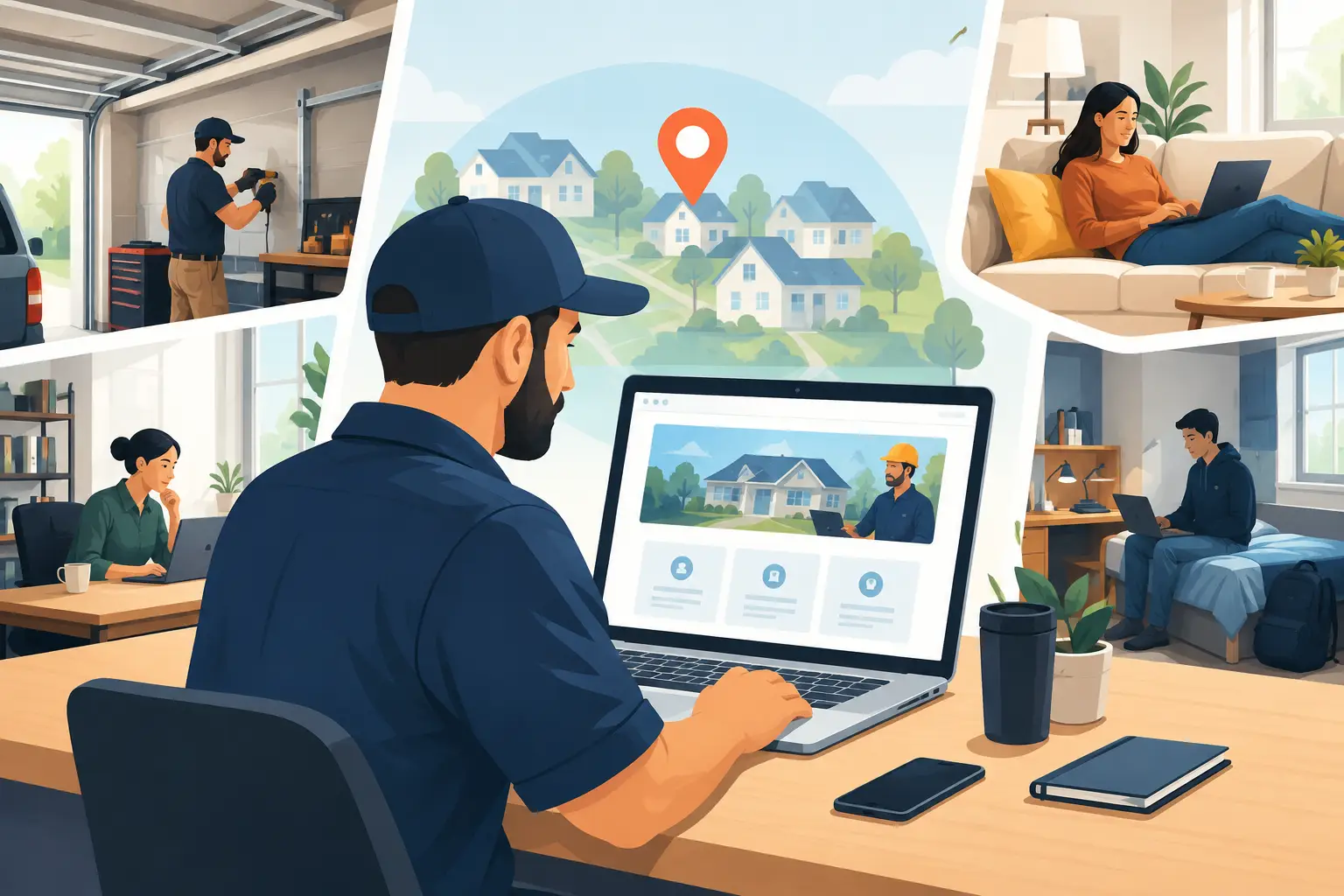
A homeowner searches “kitchen renovation contractor near me,” sees your Google ad, clicks it, and lands on your general homepage. Now they have to hunt for the service they want, confirm you work in their area, and figure out how to contact you. Most will not. That is why contractors need landing pages: they give a local prospect one clear path from search to inquiry before another contractor takes the job.
For renovation companies and trades businesses, a landing page is not a flashy marketing extra. It is a focused sales tool. It turns the attention you have already paid for through ads, SEO, social media, or local listings into a call, a form submission, or a request for an estimate.
What a Landing Page Does Differently
A standard website has a big job. It needs to explain your company, show your work, list your services, build trust, and support customers at every stage of the buying process. A landing page has a narrower assignment: convert one type of visitor for one offer, service, or location.
For example, your main website may cover bathrooms, kitchens, additions, basements, and exterior projects across several nearby communities. A landing page could speak only to homeowners looking for basement finishing in one city. The headline, project photos, proof, service details, and contact form all support that exact decision.
That focus matters because homeowners do not search in broad categories when they need work done. They search for what is in front of them: an outdated bathroom, a leaking roof, a broken furnace, or a basement they want to turn into usable space. The contractor whose page immediately answers that need usually has the advantage.
Why Contractors Need Landing Pages for Better Leads
More website traffic is not automatically more revenue. If the wrong people arrive, or the right people cannot quickly see why they should contact you, traffic becomes another number in a report. Landing pages improve the quality of the opportunity by matching the message to the search.
A homeowner clicking an ad for custom bathroom remodeling should arrive on a page about custom bathroom remodeling, not a homepage that asks them to choose among twelve services. That consistency reassures the visitor that they are in the right place. It also reduces friction, which is especially important on mobile phones, where many local searches begin.
A strong page can qualify prospects before they call. It can state the types of projects you take on, the communities you serve, typical project scope, financing availability if relevant, and the next step in your estimate process. This will not eliminate every poor-fit inquiry, but it can reduce calls from homeowners looking for work you do not perform or budgets you cannot support.
The goal is not simply more leads. It is more conversations with local people who are closer to hiring a contractor.
Landing Pages Make Paid Ads Work Harder
Google and Bing ads can put your business in front of homeowners at the exact moment they are looking for help. But ads are only half the system. The destination matters just as much.
When every ad group sends visitors to a generic page, the campaign has less relevance and fewer clear conversion paths. A targeted page lets you connect the ad, the keyword, and the offer. Someone searching for “roof replacement estimate” should see a page that addresses roof replacement, shows relevant proof, and gives them a fast way to request an estimate.
That alignment can improve conversion rates and help you get more value from the same advertising budget. It may also make it easier to identify which services and locations are producing profitable leads, rather than treating all website inquiries as one pile of data.
This is particularly useful when demand is uneven. If kitchen projects are filling your schedule but additions are slow, you can direct your budget to an additions landing page instead of hoping a broad homepage message creates the right mix of work.
They Support Local Market Dominance
Most contractors do not need leads from everywhere. They need steady demand within the service area they can serve well. A landing page gives you a practical way to speak directly to one local market without burying the message inside a general website.
A page for window replacement in a specific community can reference the service, the local area, the homeowner concern, and the proof that matters. It should be honest and useful, not stuffed with city names. The point is to show searchers that your company is a legitimate local option for the job they need.
For businesses expanding into nearby markets, location-specific landing pages can also reveal where interest is actually coming from. You may find that one suburb produces high-value renovation requests while another produces mostly small repairs. That information helps you make smarter decisions about ad spend, service coverage, staffing, and growth.
Total dominance is not about claiming every job in a region. It is about building a visible, credible presence where your ideal customers are looking.
What Should Be on a Contractor Landing Page?
The best landing pages are clear before they are clever. A homeowner should understand the service, location, and next action within a few seconds.
Start with a direct headline. “Kitchen Renovations in [City]” is stronger than a vague statement about bringing dreams to life. Follow it with a short explanation of who you help and what kind of project you handle. If you specialize in full renovations rather than patchwork repairs, say so.
The page should then build confidence. Use real project photos where possible, not generic stock images. Include reviews, credentials, warranties, years in business, manufacturer certifications, or a simple explanation of your process. For larger projects, homeowners are hiring more than a trade. They are choosing who will enter their home, manage the work, and communicate when problems come up.
Your call to action needs to be equally direct. Ask visitors to request an estimate, schedule a consultation, or call your office. A short form often performs better than a long one. Name, phone number, email, project type, and a message field are usually enough to start the conversation. If you require more details to quote accurately, your team can collect them after the lead is qualified.
Make the phone number prominent and clickable on mobile. Include the areas you serve, set realistic expectations about response time, and make it clear what happens after someone reaches out. Small details can make a busy homeowner feel more comfortable taking the next step.
One Page Per Service Is Not Always the Answer
There is a trade-off. Creating a separate page for every minor service, neighborhood, and keyword can create thin, repetitive pages that do not help users or search visibility. It also creates more marketing assets for your team to maintain.
Start with the services that matter most to your revenue and capacity. A general contractor might prioritize kitchen renovations, bathroom renovations, basement finishing, and home additions. A specialty trade might focus on the high-intent jobs that are profitable and geographically practical.
The same applies to location pages. Build them where you have a genuine service footprint, projects, reviews, or a clear ability to compete. If you serve a wide metro area, you may need a regional service page first, followed by focused pages for the communities that consistently produce good opportunities.
The right number of landing pages depends on your business model, ad budget, service area, and sales capacity. If you can only take four to five new leads a month, there is no value in generating fifty inquiries that your office cannot answer quickly. Marketing should match operational reality.
Landing Pages Are Part of a Full Lead System
A landing page cannot fix a slow callback, weak reviews, poor estimating process, or an unclear offer. It does, however, give every other marketing channel a better place to send serious prospects.
Your local SEO efforts can point searchers toward a page built for their service need. Paid ads can use pages designed around specific campaigns. Social posts can send homeowners to a focused consultation request instead of a homepage. And your analytics can show which page is producing calls and estimate requests, not merely visits.
That data creates room for improvement. If a page gets clicks but few inquiries, the message, offer, form, proof, or page speed may need work. If a page produces many leads but few booked jobs, the targeting or qualification language may need adjustment. This is how marketing becomes a managed system rather than a gamble on referrals.
Noble Media approaches landing pages as conversion touchpoints inside that larger system: understand the customer, meet them with the right message, and remove obstacles between interest and action.
Build for the Homeowner Who Is Ready to Choose
The contractor who wins online is not always the one with the largest website. It is often the one who makes the next step easiest for a local homeowner with a real problem and limited time. Give that prospect a page built around the work they need, the area they live in, and a straightforward reason to contact you. When referrals slow down, that kind of focused digital groundwork keeps the phone from going quiet.