

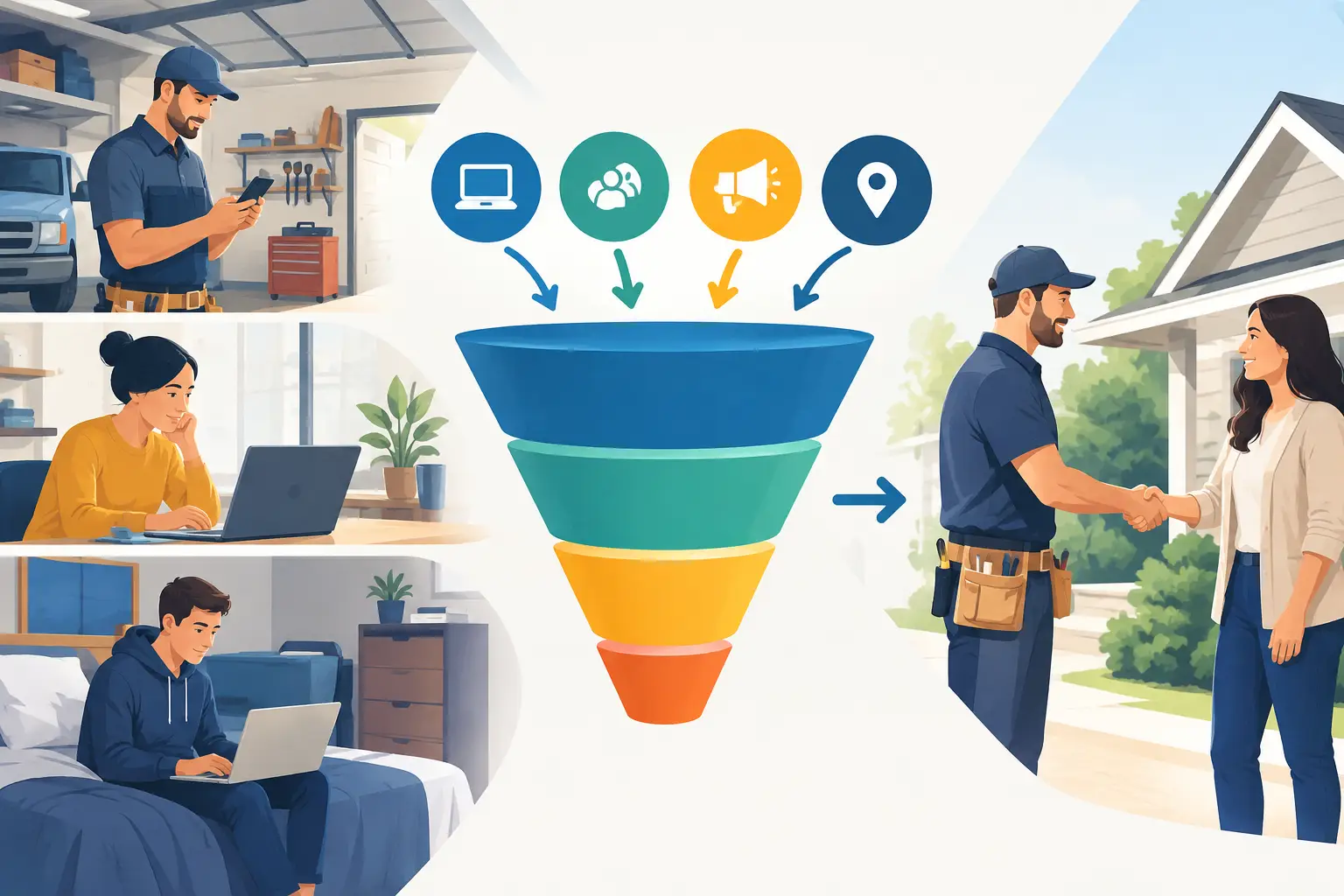
A homeowner’s furnace fails on a Sunday night. A kitchen renovation gets approved after months of planning. A property manager needs a reliable electrician before tenants move in. In each case, the contractor who gets the call is usually not the one with the broadest service list. It is the one who shows up at the right moment, looks credible, and makes the next step easy.
That is what a marketing funnel for contractors is built to do. It gives your business a dependable path from local visibility to qualified inquiries, booked estimates, and signed work. Referrals still matter. But when referrals slow down, a well-built funnel keeps your phone from going quiet.
Why contractors need more than a website
Most contractors do not have a lead problem at the top of the funnel. They have a follow-through problem in the middle and bottom. Someone finds the company on Google, clicks through to the website, sees a generic list of services, and leaves without calling. Or they submit a form and wait two days for a reply while another contractor responds in 15 minutes.
A website alone is not a marketing system. Paid ads alone are not a marketing system either. Both can create attention, but attention only becomes revenue when every stage answers the prospect’s next question: Are you local? Do you do this kind of work? Can I trust you? What will happen if I contact you?
For a contractor, the funnel must also respect operational reality. There is no point generating 40 leads a month if half are outside your service area, most want work below your minimum project size, and nobody in the office can call them back. Better leads beat more leads when your crews, estimators, and schedule are already under pressure.
The five stages of a marketing funnel for contractors
A practical contractor funnel has five connected stages: visibility, trust, inquiry, follow-up, and conversion. Each stage has a job. If one breaks down, you pay for traffic or effort that never becomes work.
1. Visibility: show up in the markets you want
Visibility is how homeowners and commercial buyers first discover you. Local search is usually the foundation. When someone searches for “bathroom remodeler near me,” “roof repair in [city],” or “licensed plumber [neighborhood],” your business needs a credible chance of appearing.
That requires more than placing your city name in a page title. Your website should clearly connect your key services to the communities you actually serve. Your business information should be consistent across major local listings. Your Google Business Profile should be active, accurate, and supported by real project photos and reviews.
Paid search can strengthen this stage, especially for urgent services or high-value project categories. The trade-off is cost. Ads can put you in front of ready-to-call prospects quickly, but they require tight geographic targeting, clear budget limits, and landing pages that match the service being advertised. Sending every ad click to your homepage is a fast way to waste money.
2. Trust: prove you are the safe choice
Contracting is a high-trust purchase. A homeowner is not buying a pair of shoes. They may be inviting your crew into their home, committing tens of thousands of dollars, or trusting you with a problem that cannot wait.
Your digital presence has to reduce that risk. Show completed work, not stock images. Use reviews that mention the kind of projects you want more of. Explain your process in plain language. Make licenses, insurance, warranty details, and service areas easy to find when relevant.
Before-and-after galleries are useful, but context makes them stronger. A short project description can show the problem, the scope, the location, and the result. For example, a basement renovation in a specific suburb tells a local prospect far more than a polished image with no details.
Trust also means being honest about fit. If you focus on full renovations, say so. If you have a minimum project value, state it tactfully. You will lose a few low-budget inquiries, but your estimating time is valuable. A clear position helps attract customers who are prepared to hire the kind of company you run.
3. Inquiry: make the next step obvious
A prospect who is ready to reach out should not have to hunt for your phone number or fill out a 12-question form. Every service page needs a direct next step, whether that is requesting an estimate, booking a consultation, or calling for urgent service.
The best call to action depends on the work. Emergency repair companies benefit from prominent click-to-call options. Renovation firms often need a consultation request that collects a few qualifying details, such as location, project type, expected timing, and budget range. This creates a better first conversation without turning the form into homework.
Keep the promise realistic. “Get a free quote” may attract volume, but it can also create expectations that do not fit complex projects. “Request a renovation consultation” often sets a more professional tone for design-build and larger remodeling work.
4. Follow-up: speed protects your marketing investment
This is where many contractor funnels leak revenue. A lead comes in while you are on a job site. By the time someone returns the call, the homeowner has contacted three competitors and booked an estimate with the first one who sounded organized.
You do not need a complicated sales department to fix this. You need a clear response standard. Assign ownership for new leads, use call tracking or form notifications, and set a target for first contact. For many inquiries, same-day response is the minimum. For urgent trade services, minutes matter.
A simple process works: acknowledge the inquiry quickly, confirm the project details, qualify for location and fit, then offer the next available appointment. If the prospect is not ready now, keep permission to follow up. A homeowner planning a remodel for spring may become a strong lead in three months, but only if your business stays visible and helpful without becoming a nuisance.
5. Conversion: turn estimates into signed jobs
A booked estimate is not the finish line. It is the handoff from marketing to sales and operations. The experience must match the confidence your website and ads created.
Show up when promised. Bring a clear process. Explain what happens after the site visit. Send estimates when you said you would, and follow up with purpose rather than a vague “just checking in.” Prospects often delay because they are uncertain, not because they are uninterested.
Your estimate can reinforce the decision with scope clarity, timeline expectations, payment terms, and proof of similar work. For larger projects, a professional proposal is part of the marketing funnel. It gives the customer something concrete to compare when competitors are relying on a rough number sent by text.
Build the funnel around your ideal job
The strongest funnels begin with a hard business decision: what work do you want more of? “More leads” is too broad. A roofing company may want insurance-related replacements within a 30-mile radius. A remodeler may want kitchen projects above a certain budget. An HVAC contractor may need more maintenance memberships to stabilize seasonal demand.
This decision shapes every part of the funnel. It determines the keywords you target, the project photos you feature, the questions on your contact form, and the language in your ads. It also prevents a common problem: marketing that produces activity but not profitable work.
Service area matters just as much. Contractors do not need to dominate an entire state to grow. It is often smarter to own the neighborhoods and cities where travel is reasonable, referrals can compound, and crews can work efficiently. Local market dominance is built one service area at a time.
Measure the points that affect profit
Do not judge marketing by website visits alone. Traffic can look impressive while your estimating calendar stays empty. Track the numbers that show whether the funnel is producing real opportunities.
At minimum, watch lead volume, lead source, response time, booked estimate rate, close rate, average job value, and cost per acquired customer. Review them by service type and location when possible. If paid ads bring plenty of calls but few qualified jobs, the issue may be targeting, offer language, landing page messaging, or the way calls are handled.
There is no universal benchmark because trade, market, price point, and seasonality all affect performance. The goal is not to copy another contractor’s numbers. The goal is to identify where your own process loses good prospects, then improve that point before spending more on lead generation.
Give your funnel time, then improve it
A marketing funnel is not a one-time setup. Reviews accumulate, search positions move, ad costs change, and the jobs you want may shift as your business grows. The right approach is steady improvement: test the message, review lead quality, listen to sales calls, update service pages, and double down on the channels that bring work your team actually wants.
Noble Media approaches this work with a contractor-first mindset because marketing should not create another full-time job for the owner. The system should make your digital impact loud, clear, and easier to manage while you focus on crews, customers, and completed work.
The next time referrals soften, do not wait for the phone to start ringing on its own. Build a clear path for the right local customer to find you, trust you, contact you, and choose you.