

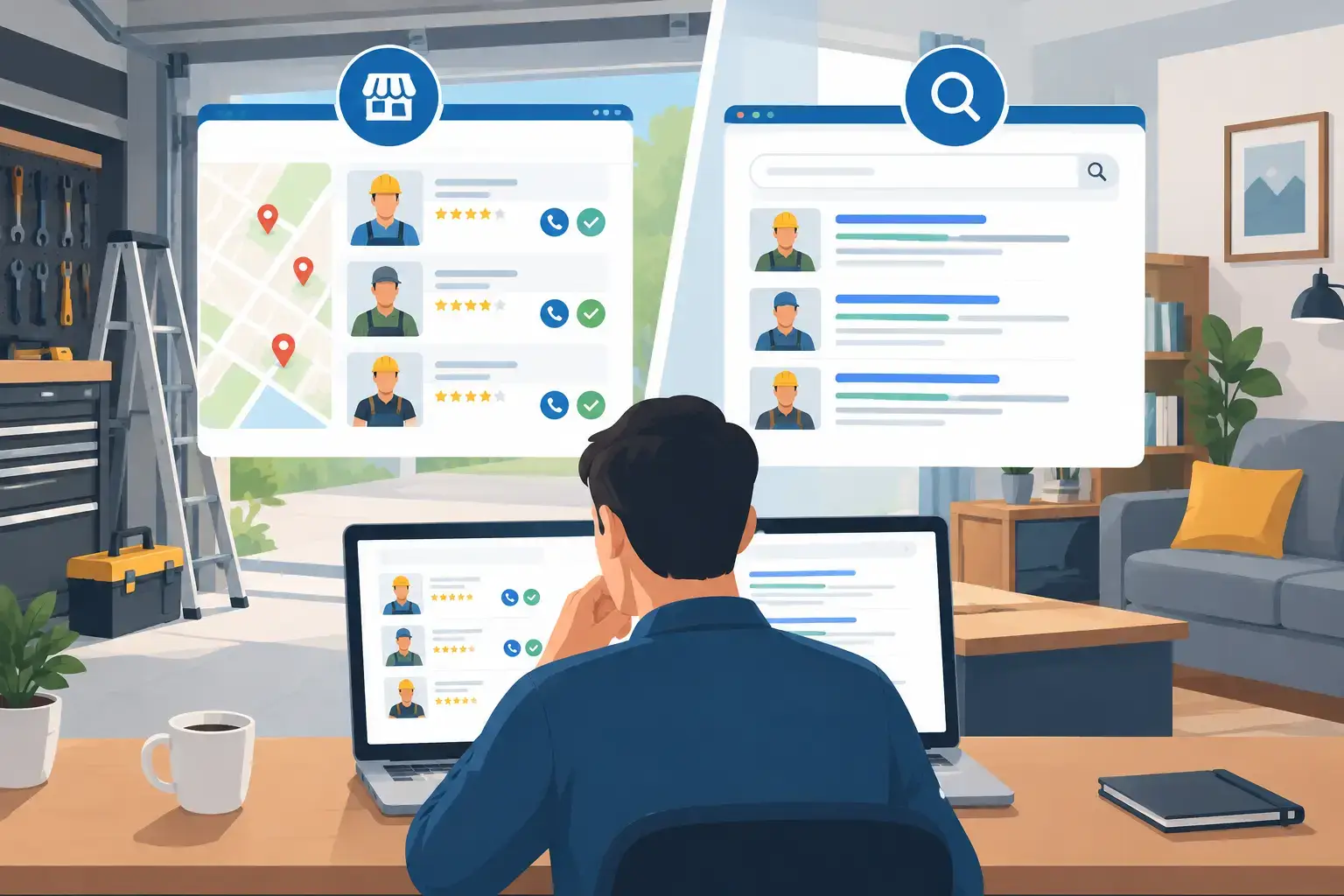
A homeowner with a leaking roof, failed furnace, or half-finished kitchen does not browse Google casually. They want a capable local contractor, a clear next step, and some proof they will not regret the call. That is the real decision behind local services ads versus search: which channel puts your business in front of serious local buyers at the moment they are ready to act?
For renovation companies and trade businesses, the answer is rarely “pick one and forget the other.” Local Services Ads and traditional Google Search campaigns reach prospects differently, create different expectations, and require different follow-up. The better choice depends on your trade, your service area, your capacity, and the type of work you want more of.
What Local Services Ads Do Differently
Local Services Ads, often called LSAs, appear prominently at the top of certain Google results. They are built for qualifying local service categories such as plumbing, electrical, HVAC, roofing, cleaning, and some home improvement services. Instead of a standard text ad that sends a prospect to your website, an LSA highlights your business profile, rating, service area, hours, and contact options.
For a busy homeowner, this format reduces friction. They can call, message, or request a booking without comparing five contractor websites first. In many cases, Google also displays a screening badge after the business meets applicable verification requirements. That added trust can matter when the work is urgent or the homeowner has never heard of your company.
LSAs are generally charged per lead rather than per click. On paper, that sounds safer than paying every time someone visits your site. But the lead is not automatically profitable. You may still receive calls outside your service area, requests for work you do not offer, price shoppers, or homeowners who do not respond after making contact.
The advantage is speed and visibility. The trade-off is control. You have less room to explain why your renovation company is different, show project photos, or guide prospects through a carefully built estimate process before they contact you.
How Google Search Ads Win More Specific Work
Traditional Google Search ads appear when someone searches a phrase you target, such as “bathroom renovation contractor near me,” “commercial electrician,” or “roof replacement estimate.” You pay when someone clicks the ad, then send them to a landing page or relevant service page on your website.
That extra step is not a weakness if the campaign is built properly. It is where you can qualify the lead before the phone rings. A landing page can make your service area clear, show the type of projects you take on, feature reviews, explain your process, and ask for the details needed to assess whether the job is a fit.
Search also gives you more precision over the work you want to pursue. A remodeling company can run separate campaigns for kitchens, bathrooms, additions, and basement finishing. A plumber can promote emergency repair calls separately from planned water-heater replacements. You can adjust messaging by city, season, device, time of day, and keyword intent.
That control matters for established contractors who are not simply chasing volume. If your crews are booked for small repairs but you want more full-project renovations, Search ads give you more ways to filter out low-value demand and promote the jobs that support your growth plan.
Local Services Ads Versus Search: The Real Comparison
The simplest distinction is this: Local Services Ads help homeowners choose a provider quickly, while Search ads help you shape the prospect’s decision before they contact you.
LSAs are often strongest for high-intent, immediate-need services. Think burst pipes, no-heat calls, damaged roofs, lockouts, appliance repair, or other problems where the homeowner wants a qualified local business now. Reviews, responsiveness, availability, and a well-managed profile carry significant weight.
Search ads are often better for considered purchases. A homeowner planning a kitchen remodel may research for weeks, compare styles, read reviews, and request multiple estimates. They need more information than an LSA profile can provide. A strong website and project-specific landing page give you the room to establish credibility and steer the inquiry toward your ideal project size.
Neither channel is inherently better. A roofing contractor after storm damage may find LSAs produce a fast stream of calls. The same company may use Search to build a steady pipeline for planned replacements and premium roofing systems. A general contractor focused on additions may find Search far more useful because their buyers need proof of design expertise, process, and past results before picking up the phone.
Cost Per Lead Is Not the Number That Matters Most
Contractors often ask which channel has the lower cost per lead. That is a fair question, but it can lead to the wrong decision. A cheap lead that never answers, falls outside your service area, or wants a job you do not take is not cheap. It is a distraction for your office and estimator.
Track cost per qualified opportunity instead. Then track booked estimates, closed jobs, average job value, and gross profit by source. If one channel delivers fewer leads but produces larger, better-fit projects, it may be the clear winner.
This is especially true for renovation businesses. A $40 LSA lead for a small repair may look attractive until it consumes two hours of coordination and does not convert. A $150 Search lead for a $45,000 bathroom renovation may be the better investment by a wide margin.
Your team’s response time affects these numbers, too. Local leads are impatient. If calls roll to voicemail during business hours, or web inquiries wait until tomorrow for a response, the marketing budget is doing work your sales process is not finishing.
When LSAs Should Be Your First Move
Start with Local Services Ads when your business is eligible, your Google Business Profile is accurate, and you can answer or return calls quickly. They make particular sense when you have room for more service calls, operate in a tightly defined area, and have enough positive reviews to compete locally.
Before turning them on, clean up the basics. Confirm your business hours, service categories, insurance and licensing information where required, service areas, and review profile. Decide who owns lead follow-up. Make sure that person understands which jobs you want, which jobs you decline, and how quickly to respond.
LSAs can also be a practical testing ground for a newer paid lead program. They give you a direct view of what nearby homeowners ask for, how often calls turn into estimates, and where demand is coming from. Just do not mistake a full call log for a healthy pipeline. Quality has to be measured, not assumed.
When Search Ads Deserve More Budget
Put more weight behind Search when you need control over lead quality or want to promote specific services. It is often the smarter investment for custom renovations, larger project values, specialty trades, and businesses with several locations or a broader regional footprint.
Search is also essential when your website can do the selling that an LSA cannot. Before-and-after galleries, local case studies, financing details, warranty information, and a clear estimate request process all help turn a cautious researcher into a qualified inquiry.
The campaign structure matters. Sending every ad click to your homepage wastes intent. Someone searching for a basement renovation in one city should land on a page that speaks directly to basement projects, that market, and the next action you want them to take.
At Noble Media, this is where contractor-first funnel planning matters: define the ideal customer, match the page and message to the service they need, then measure what happens after the form submission or phone call.
The Best Approach for Many Contractors: Use Both With Clear Roles
For many trade businesses, the strongest strategy is not local services ads versus search as a winner-take-all fight. It is assigning each channel a job.
Let LSAs capture urgent, ready-to-call homeowners in your core service area. Let Search campaigns target higher-value services, city-specific demand, and customers who need more confidence before committing. Your website, reviews, call handling, and follow-up process connect the two.
Start with a budget you can evaluate honestly. Run the campaigns long enough to gather meaningful data, then review not only leads but outcomes. Which source produces calls? Which produces estimates? Which produces signed work? Which source brings projects your team actually wants more of?
The contractor who wins local search is not always the one spending the most. It is the one who knows which jobs are worth pursuing, responds like the work matters, and gives local homeowners a clear reason to choose them.